Media Under Fire on Private Networks: How the Far Right is Stealthily Destroying the Reputation of News Organizations on WhatsApp
Como redes privadas de comunicação, sobretudo o WhatsApp, têm sido usadas para disseminar ataques contra a mídia e jornalistas.
Data:2026
Autoria:Viktor Chagas
Tipo:Artigo Original
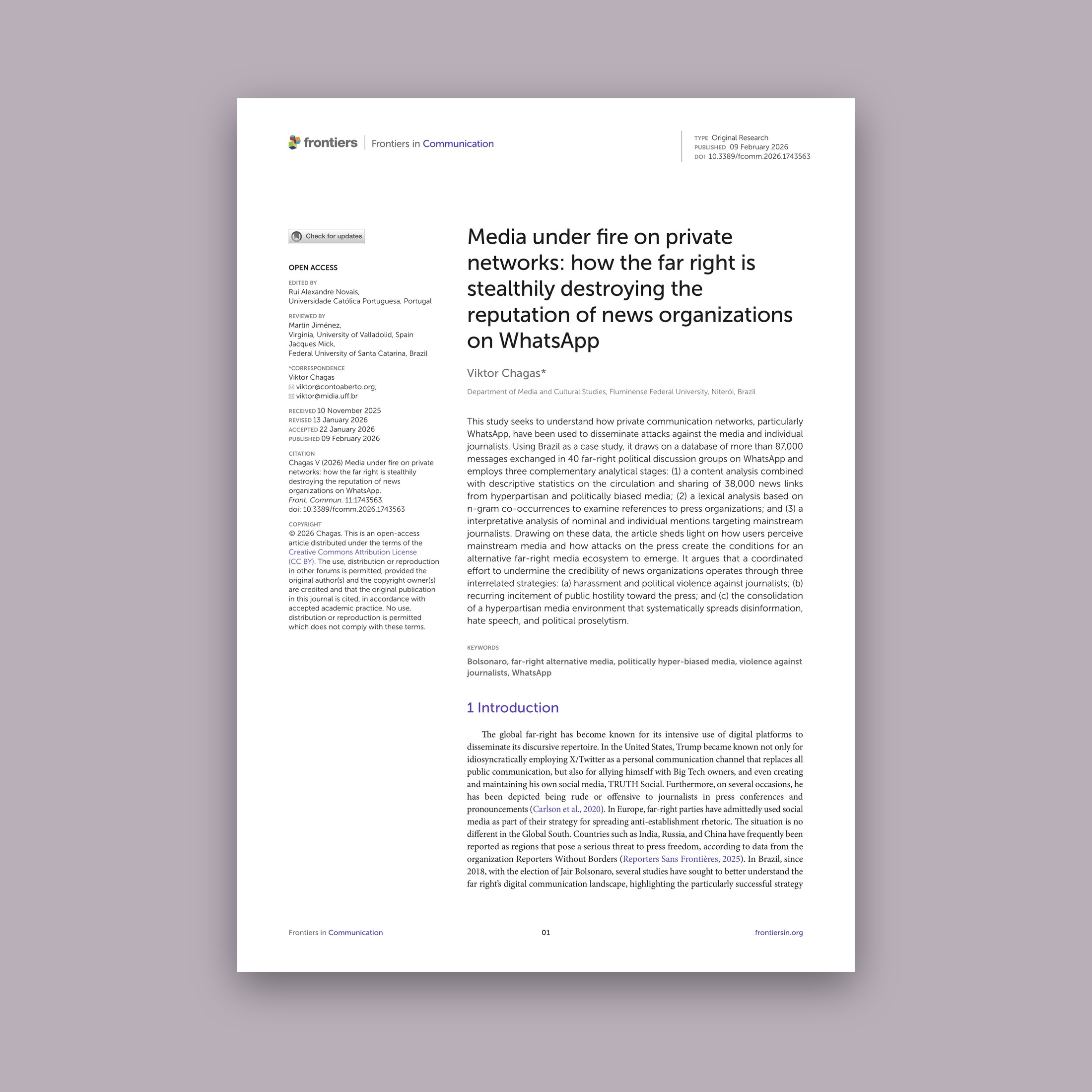
This study seeks to understand how private communication networks, particularly WhatsApp, have been used to disseminate attacks against the media and individual journalists. Using Brazil as a case study, it draws on a database of more than 87,000 messages exchanged in 40 far-right political discussion groups on WhatsApp and employs three complementary analytical stages: (1) a content analysis combined with descriptive statistics on the circulation and sharing of 38,000 news links from hyperpartisan and politically biased media; (2) a lexical analysis based on n-gram co-occurrences to examine references to press organizations; and (3) a interpretative analysis of nominal and individual mentions targeting mainstream journalists. Drawing on these data, the article sheds light on how users perceive mainstream media and how attacks on the press create the conditions for an alternative far-right media ecosystem to emerge. It argues that a coordinated effort to undermine the credibility of news organizations operates through three interrelated strategies: (a) harassment and political violence against journalists; (b) recurring incitement of public hostility toward the press; and (c) the consolidation of a hyperpartisan media environment that systematically spreads disinformation, hate speech, and political proselytism.
Créditos
Autor: Viktor Chagas
Como citar este estudo
1
CHAGAS, V. Media under fire on private networks: how the far right is stealthily destroying the reputation of news organizations on WhatsApp. Frontiers in Communication, v. 11, 1743563, 2026.