Artigo
Quiddity and Universality: The Transnational Origins of Humorous Far-Right Memes
Como redes bolsonaristas se apropriam de memes de humor transnacionais, adaptando-os a realidades locais ou preservando seu caráter universal.
Como redes bolsonaristas se apropriam de memes de humor transnacionais, adaptando-os a realidades locais ou preservando seu caráter universal.
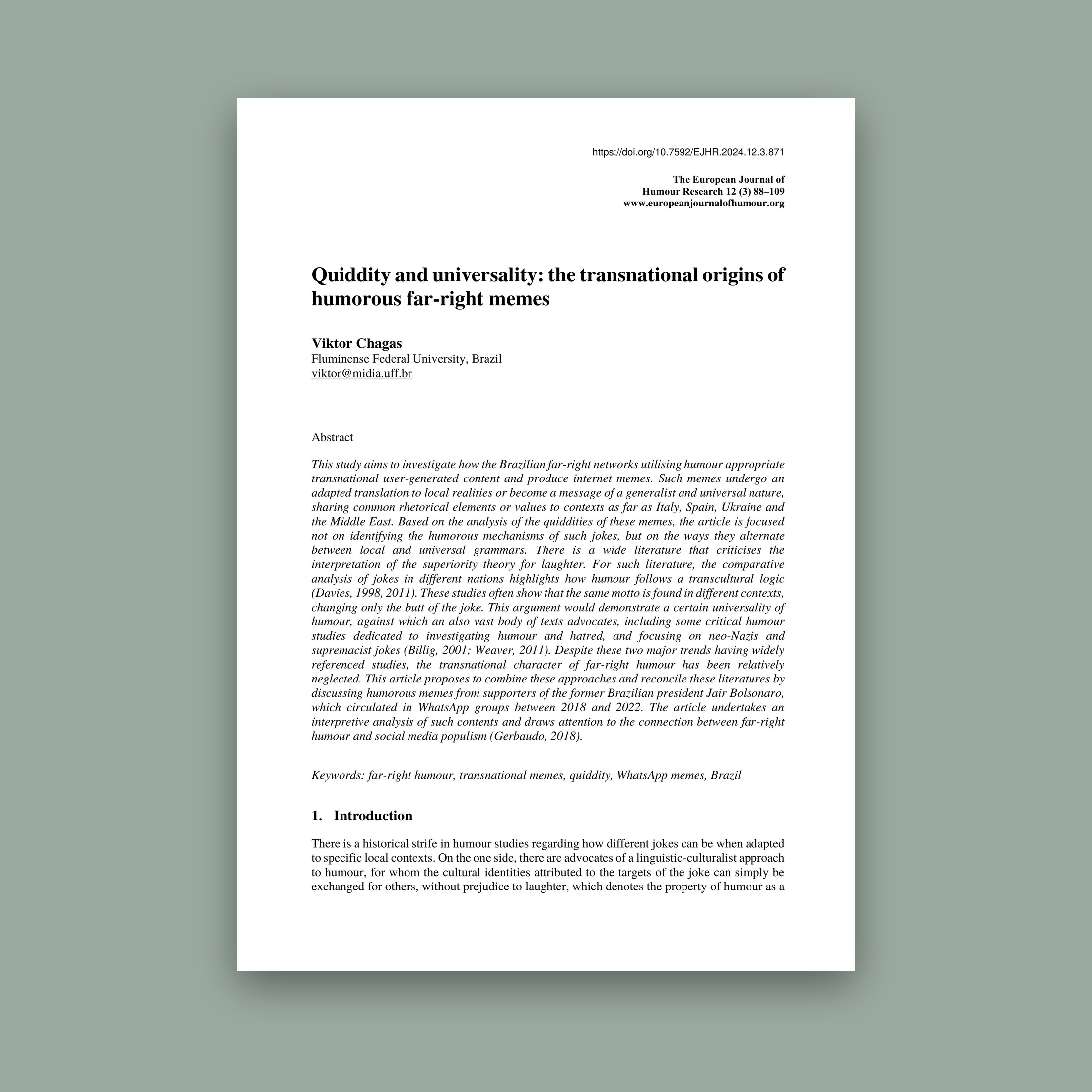
This study aims to investigate how the Brazilian far-right networks utilising humour appropriate transnational user-generated content and produce internet memes. Such memes undergo an adapted translation to local realities or become a message of a generalist and universal nature, sharing common rhetorical elements or values to contexts as far as Italy, Spain, Ukraine and the Middle East. Based on the analysis of the quiddities of these memes, the article is focused not on identifying the humorous mechanisms of such jokes, but on the ways they alternate between local and universal grammars. There is a wide literature that criticizes the interpretation of the superiority theory for laughter. For such literature, the comparative analysis of jokes in different nations highlights how humour follows a transcultural logic (Davies, 1998, 2011). These studies often show that the same motto is found in different contexts, changing only the butt of the joke. This argument would demonstrate a certain universality of humour, against which an also vast body of texts advocates, including some critical humour studies dedicated to investigating humour and hatred, and focusing on neo-Nazis and supremacist jokes (Billig, 2001; Weaver, 2011). Despite these two major trends having widely referenced studies, the transnational character of far-right humour has been relatively neglected. This article proposes to combine these approaches and reconcile these literatures by discussing humorous memes from supporters of the former Brazilian president Jair Bolsonaro, which circulated in WhatsApp groups between 2018 and 2022. The article undertakes an interpretive analysis of such contents and draws attention to the connection between far-right humour and social media populism (Gerbaudo, 2018).
1
CHAGAS, V. Quiddity and universality: the transnational origins of humorous far-right memes. The European Journal of Humour Research, v. 12, n. 3, p. 88-109, 2024.