Research
Deliberative Democracy in the Face of the Crisis of Democracy: Contributions, Dilemmas and Paths
Investigation into the dilemmas of the crisis of contemporary democracies.
Investigation into the dilemmas of the crisis of contemporary democracies.
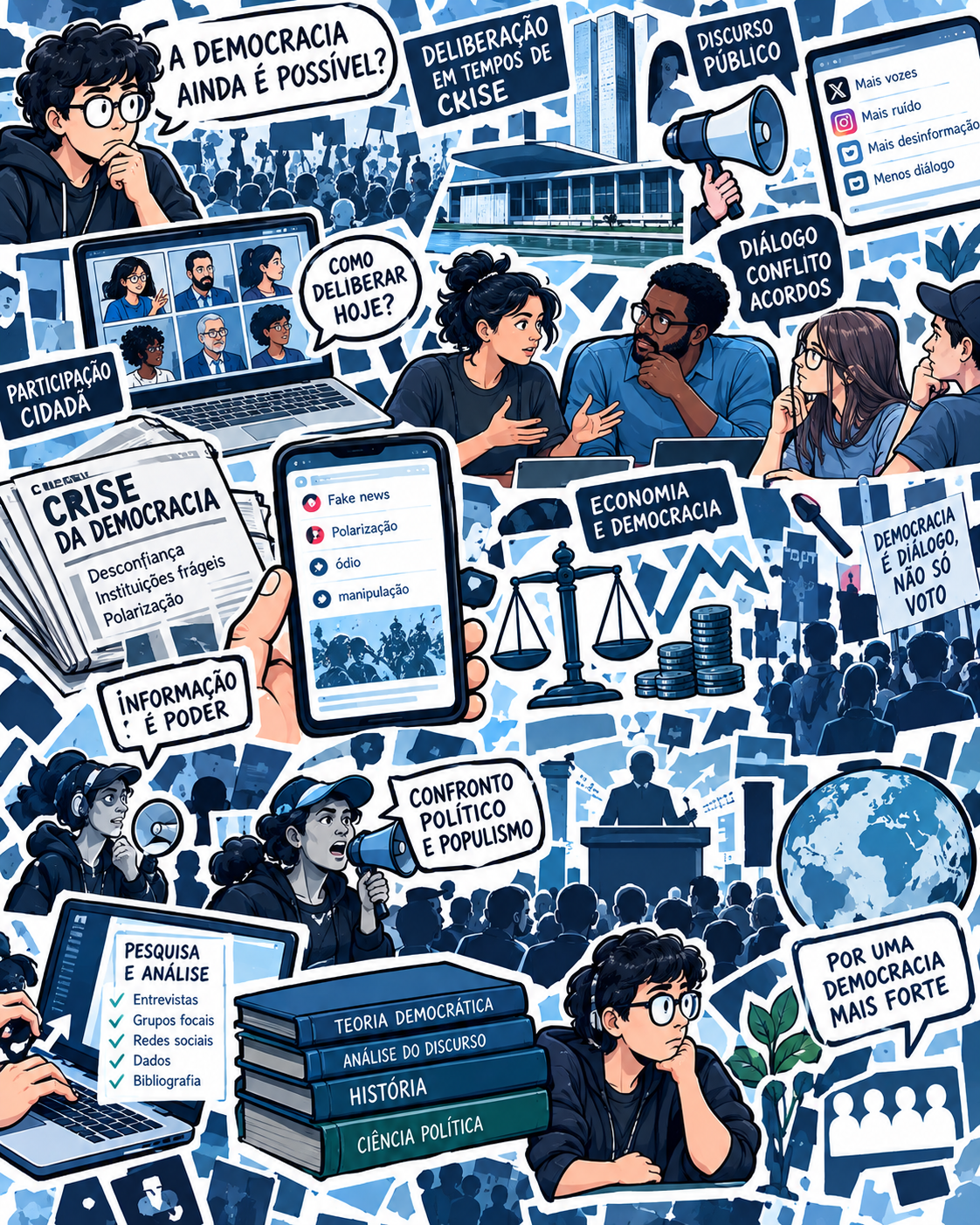
This project seeks to investigate the dilemmas that the contemporary crisis of democracy poses to the deliberationist theory of democracy, as well as the possible contributions this approach can make to understanding and eventually overcoming this moment of uncertainty and turbulence. A conceptual strand that has become very influential in the debate on democratic theory since the 1990s, the deliberationist approach to democracy faces many difficulties in the effort to move from a perspective more focused on the design and study of dialogical interactions to a broader bias that thinks of democracy through the eyes of deliberation (Chambers, 2009; Steiner, 2012; Dobson, 2014; Bachtiger Parkinson, 2018). This research project seeks to mobilize the deliberationist perspective to reflect on many of the actual dilemmas and challenges posed today to democracy. We are interested in investigating the approach’s capacity to respond to a scenario in which many of the liberal values on which the deliberationist debate was founded (whether as endorsement or as critique) seem to be in check. It is not, therefore, a proposal to investigate the existence or not of deliberation or the deliberative quality of contemporary debates. Recovering the normativity of the theory, we propose to think about what it has to say about democratic erosion, how it must be conceived to say something about this phenomenon and how it can contribute to overcoming it. To this end, the project starts from a reconstruction of the diagnosis of the crisis of democracy. Next, the investigation is devoted to four themes often neglected by deliberationists and that are central for the perspective to critically discuss the contemporary scenario: (1) the forms, challenges and possibilities of public discussion in times of communicative abundance, with special attention to the role of extra-verbal forms of discursive production; (2) the relationship between economics and democracy, focusing particularly on the limits of deliberative participation in contexts of fiscal strangulation of the Democratic State and the way economic asymmetries influence the discursive capacity of certain actors; and (3) the contours of contemporary political confrontation, highlighting the expansion of forms of activism marked by a context conducive to populist communication strategies. Methodologically, the project operates with data generated through interviews, focus groups, social media scraping, databases produced in previous projects and bibliographic research. The analysis is carried out through interpretive techniques, which combine elements of discourse analysis, historical approaches and theoretical analysis.