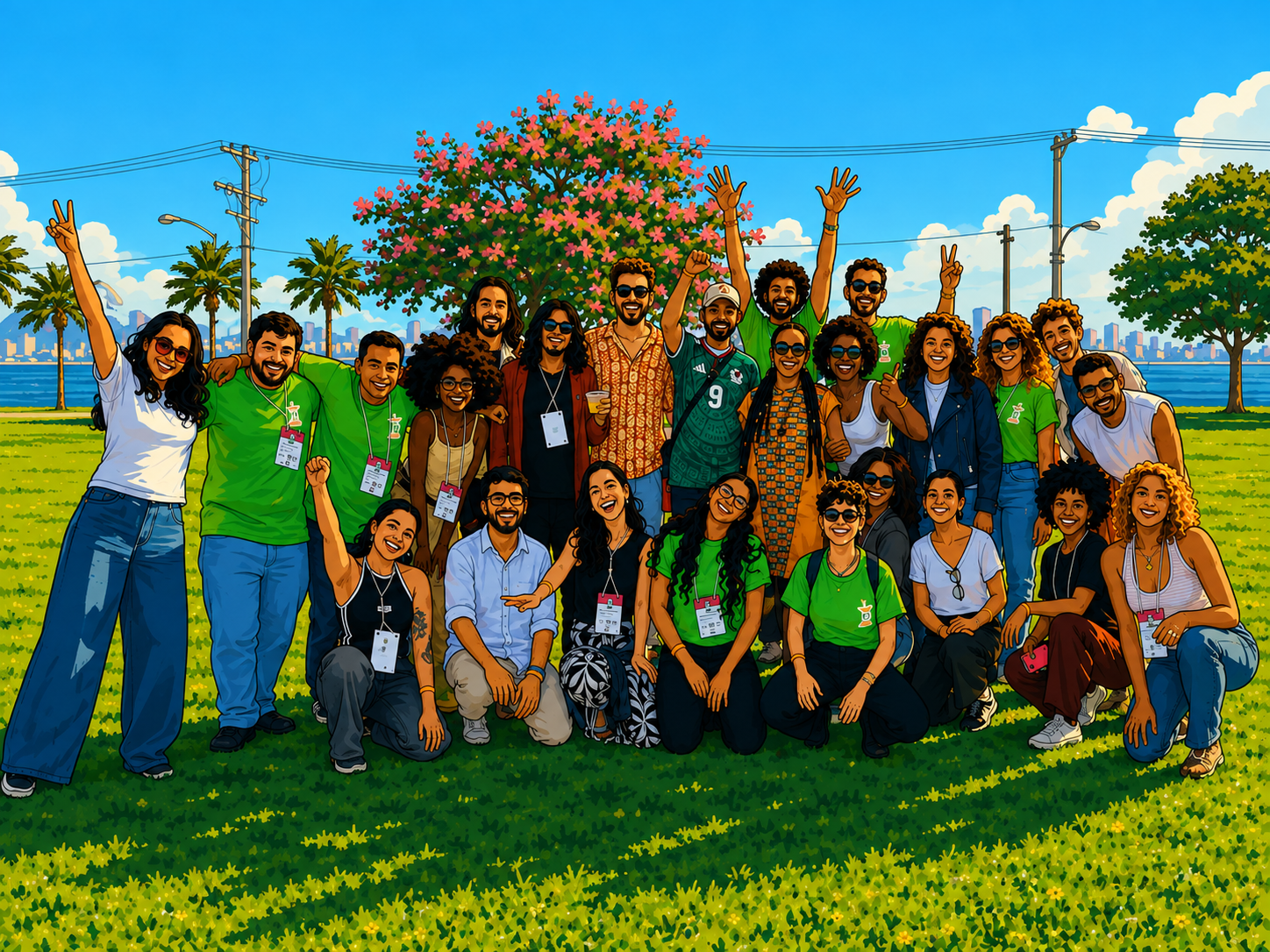
About coLAB
A Little About coLAB
Research Laboratory for Communication, Political Cultures and Economies of Collaboration at the Fluminense Federal University.
Research Laboratory for Communication, Political Cultures and Economies of Collaboration at the Fluminense Federal University.
The Research Laboratory for Communication, Political Cultures and Economies of Collaboration (coLAB/UFF) is a research group created in November 2010 and led, since its founding, by Viktor Chagas, associate professor in the Department of Cultural and Media Studies and in the Graduate Program in Communication at the Fluminense Federal University. coLAB conducts investigations aimed at understanding the interfaces between digital culture and political culture, with an emphasis on studies of contentious repertoires and the strategic uses of affordances on digital platforms, platform culture and online politics, influence operations, and the circulation of disinformation and hate speech, among other topics. Associated with the National Institute of Science and Technology in Digital Democracy (INCT.dd), the group brings together researchers dedicated to the field of political communication, at different levels of training. Its research lines cover studies on: communication strategies and public opinion, political cultures and collective action, and humor and political discussion.
coLAB is responsible for a set of projects developed in an interdisciplinary manner and with the support of its members and inter-institutional partners. Besides the National Institute of Science and Technology in Digital Democracy (INCT.dd), the laboratory is also part of the National Network to Combat Disinformation (RNCD), and maintains close, formal collaboration with the Institute for Technology and Society of Rio (ITS Rio) and FGV Comunicação, through the School of Communication, Media and Information (ECMI); as well as cooperation already carried out with Aláfia Lab, the Image and Data Science Laboratory (Labic) of the Federal University of Espírito Santo; and partner groups and laboratories such as Margem (UFMG), MiDiCom (UFF), GCodes (UFPA), CPOP (UFPR), and more.
More details about some of the activities carried out by coLAB can be found in the Projects section.
For a portfolio of press mentions of studies and projects developed by coLAB researchers, visit our clipping. The clipping is updated periodically with news items that echo our activities.
An overview of the main milestones in the laboratory's history, from its founding to the present day. Click on an event to read the details.
The Research Laboratory for Communication, Political Cultures and Economies of Collaboration (coLAB) is founded in November at the Fluminense Federal University, under the leadership of Viktor Chagas.
The P3 outreach program brought together the outreach activities of the research groups coLAB (coordinated by Viktor Chagas) and Media Ludens (coordinated by Emmanoel Ferreira), including a film club and a series of workshops on digital culture.
Before any other research and outreach activities associated with the topic emerged, Tsai Yi Jing defends her undergraduate thesis in Media Studies, supervised by Viktor Chagas.
Milena Pereira (PIBIC/CNPq) and Viktor Chagas (advisor) receive 2nd place in the Applied Social Sciences category for the project "The Statute of Collaboration: Appropriations of the Web for Processes of Collective Construction of Narratives".
In June 2012, the #memeclube emerges, a mix between a film club and an academic seminar, featuring a thematic curatorship and small exhibition clusters on the Brazilian memesphere. At its debut, the event was organized around a debate on the LOLcat genre and the community producing memes around the theme.
The #MUSEUdeMEMES emerges as an outreach project, still without a platform or an established collection.
coLAB joins the Wikipedia at the University Program, in which students and professors come together to create content for Wikipedia.
Viktor Chagas receives 1st place in the Best Doctoral Dissertation category, with the dissertation "Extra! Extra! Newsstand Vendors and Newsstands as a Space of Disputes over the Control of Press Distribution and the Political Economy of the Media".
Luan Dutra (PIBITI/CNPq) and Viktor Chagas (advisor) receive 1st place in the General category for the project "Cooperation Games: Dynamics of Conflict and Negotiation in Educational Materials for University-Age Youth".
Janderson Pereira Santa Clara (outreach scholarship holder) and Viktor Chagas (advisor) receive 1st place in the Communication category for the project "Big Data Office: Study and Application of Big Data Analysis on Wikipedia".
Viktor Chagas is awarded for the project "Overlapping Webs: An Analytical Model for Use in Works on the Political Economy of Printed Media".
A new outreach project is created, still within the scope of the Center for Applied Production and Research in Electronic Games and Collaborative Networks (P3). The project aimed to establish an innovation and digital intelligence agency, which would later become the Model Memes Office.
coLAB researchers develop their first studies on memes and elections. Preliminary results are presented the following year at Compolítica and, later, at other conferences in the field.
The #MUSEUdeMEMES is inaugurated in June 2015, after years of research and development. From its origin, the outreach project has been dedicated to the preservation and study of meme culture as digital heritage.
Luan Dutra (PIBITI/CNPq) and Viktor Chagas (advisor) receive 1st place in the Humanities category for the project "Cooperation Games: Dynamics of Conflict and Negotiation in Educational Materials for University-Age Youth".
Fernanda Freire defends her thesis on the memes of the 2014 elections and the Eduardo Jorge case, supervised by Alessandra Aldé (Uerj) and co-supervised by Viktor Chagas.
With the support of the Casa de Rui Barbosa Foundation and the Getulio Vargas Foundation, and as an integral part of the project "Preserving the Memory of the Olympics: Processes and Actions", the virtual exhibition "The Memes' Olympics" is inaugurated, curated by #MUSEUdeMEMES.
The Big Data Office project is converted into the Model Memes Office, an innovation and digital intelligence agency devoted to the study of the memesphere, with a focus on the activity of digital influencers, coordinated actions, and more.
As a result of the activities carried out during Viktor Chagas's postdoctoral fellowship under the supervision of Professor Wilson Gomes at the Federal University of Bahia, coLAB becomes associated with the National Institute of Science and Technology in Digital Democracy, based in Salvador, BA.
Carlos Bonifácio (PIBINOVA/UFF) and Viktor Chagas (advisor) receive 3rd place in the Human/Social Sciences/Linguistics category for the project "Model Memes Office".
In May, coLAB holds an international symposium combined with the launch of the exhibition "The politics of memes and the memes of politics", which received thousands of visitors at the Catete Palace, Museum of the Republic. The symposium brought together about 200 researchers from across Brazil and international guests such as Whitney Phillips (Syracuse University) and Ryan Milner (College of Charleston).
A new website is developed to host the #MUSEUdeMEMES project.
Professor Viktor Chagas takes over as executive secretary of the Brazilian Association of Communication and Politics Researchers (Compolítica) for the 2019-2021 term, alongside colleagues Rafael Cardoso Sampaio (president) and Rayza Sarmento (vice-president).
Start of the activities of the project "Deliberative democracy in the face of the crisis of democracy: contributions, dilemmas and paths", led by Ricardo Fabrino Mendonça (UFMG), in partnership with professors Viktor Chagas (UFF), Rayza Sarmento (UFV), Franck Tavares (UFG), Camilo Aggio (UFMG) and Filipe Motta (UFMG).
Viktor Chagas edits the first collection to emphasize meme culture in Brazil, with translated and previously unpublished texts, predominantly by international authors.
Start of the activities of the project "The circulation of dangerous speech in the 2020 Brazilian elections", led by the Getulio Vargas Foundation. The proposal won a Facebook Research call on disinformation. Viktor Chagas takes part as a project member.
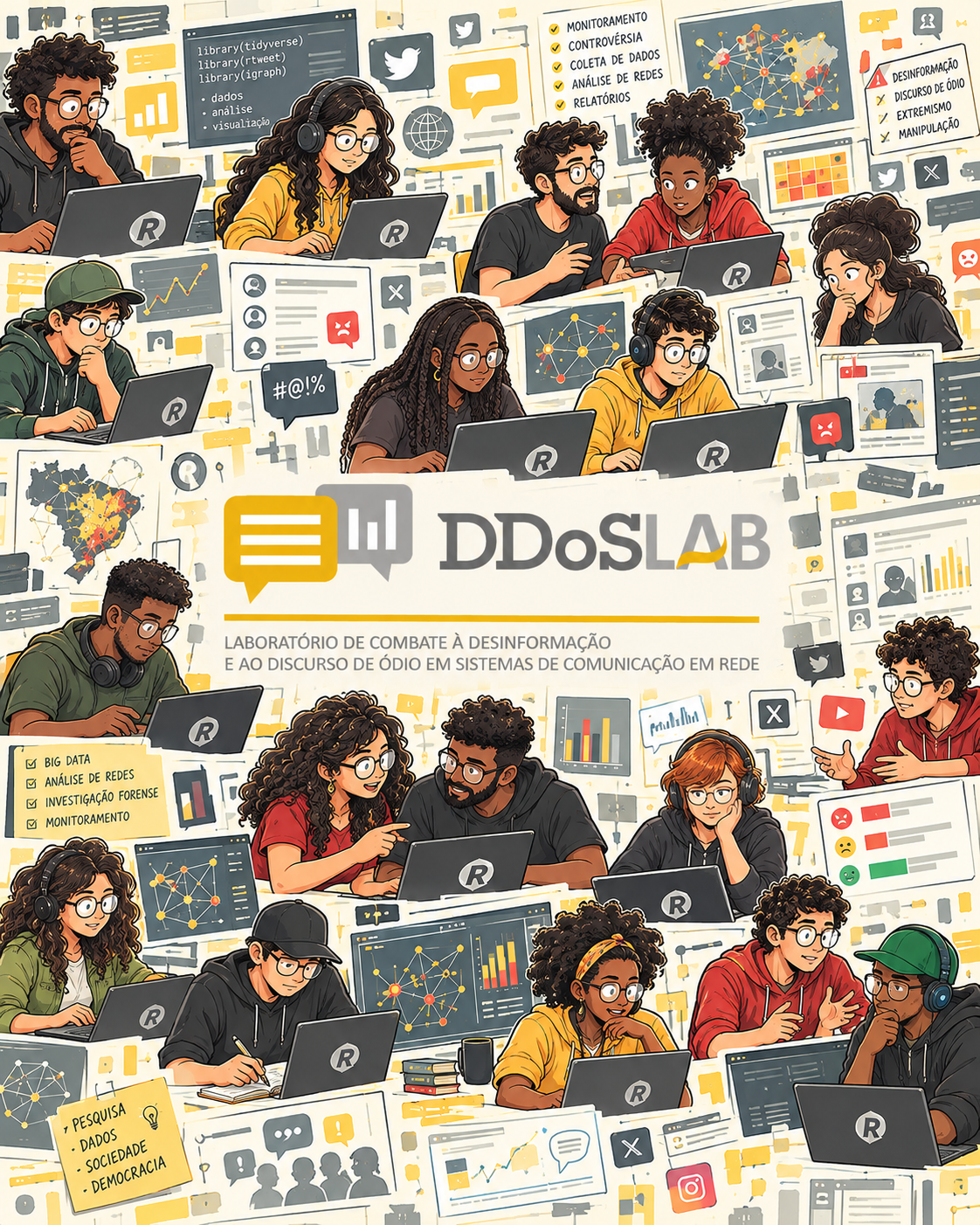
coLAB inaugurates a new innovation and digital intelligence agency project, serving as a laboratory to combat disinformation and hate speech in networked communication systems. DDoS Lab incorporates and renames the former Model Memes Office project, which in turn grew out of the accumulated experience of the Big Data Office. DDoS Lab receives support from a parliamentary amendment by then federal deputy Alessandro Molon (PSB-RJ) and from an internal equipment call by INCT.DD. The funds gave rise to the laboratory facilities of DADOS, the physical space that currently hosts coLAB, and made it possible to publish a series of research reports with situational analyses on topics within the group's scope.
The second volume of the A Cultura dos Memes collection, now focusing on Brazilian cases and predominantly featuring texts by national authors, is released, also edited by Viktor Chagas.
The DADOS laboratory, the physical home of coLAB (and also of MiDICom, another group associated with PPGCOM UFF), at the Institute of Art and Social Communication, is inaugurated.
Start of the activities of the project "Restoring Trust in Journalism", led by professors Mark Boukes and David Blanco Herrero (Universiteit van Amsterdam), together with 33 other countries.
Start of the activities of the DNA project, led by IBICT. Viktor Chagas takes part as a researcher associated with the partner group Labic/Ufes.
The exhibition MEME: No Br@sil da Memeficação (MEME: In Br@zil's Memefication), curated by Clarissa Diniz and Ismael Monticelli, premieres at the Banco do Brasil Cultural Center São Paulo (CCBB-SP). In the same year, it tours Brasília and then Belo Horizonte and Rio de Janeiro, already in 2026. #MUSEUdeMEMES and coLAB take part as guest curators of one of the exhibition's sections, conducting interviews with humorists, comedians, digital influencers and meme makers.
In July, the 36th annual edition of the longest-running and most important humor studies conference is held for the first time in the Global South and Latin America, in Niterói, at the Fluminense Federal University. coLAB is the host of the conference, which brought together 200 participants from 35 different countries, 166 papers presented across 56 sessions. In all, there were 13 national and international guests, including Raúl Pérez (La Verne University), Héctor Fernández L'Hoeste (Georgia State University), Daniel Kupermann (USP), Helen Fernandes (Malfeitona), and Porta dos Fundos actresses Clarice Falcão, Adriana Falcão, Dida Camero and Bella Camera, among others.
For organizing the 36th edition of its annual conference, the ISHS grants co-organizers Viktor Chagas and João Paulo Capelotti the ISHS Service Award.
Viktor Chagas is the guest editor of the special issue of the Journal of Visual Political Communication, with the dossier Dark and Unethical Visual Politics.