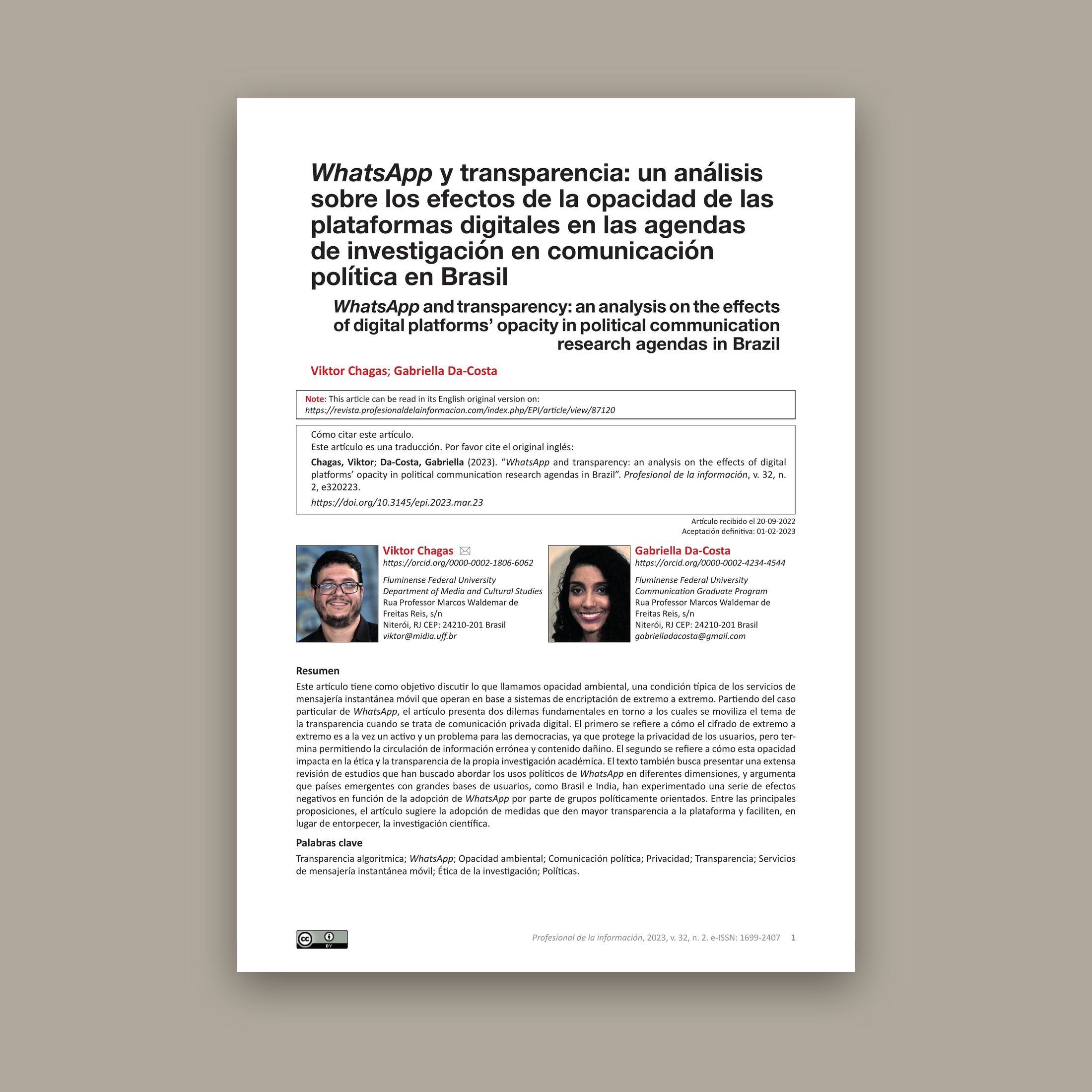
WhatsApp and Transparency: An Analysis of the Effects of Digital Platform Opacity on Political Communication Research Agendas in Brazil
On WhatsApp's environmental opacity and its effects on the ethics and transparency of academic research itself in political communication in Brazil.
Date:2023
Authors:Viktor Chagas and Gabriella Da-Costa
Type:Original Article
This article aims to discuss what we call environmental opacity, a condition typical of mobile instant messaging services that operate on the basis of end-to-end encryption systems. Starting from the particular case of WhatsApp, the article presents two fundamental dilemmas around which the theme of transparency is mobilized when it comes to private digital communication. The first concerns how end-to-end encryption is both an asset and a problem for democracies, since it protects users’ privacy but ends up allowing the circulation of misinformation and harmful content. The second concerns how this opacity impacts the ethics and transparency of academic research itself. The text also seeks to present an extensive review of studies that have sought to address the political uses of WhatsApp in different dimensions, and argues that emerging countries with large user bases, such as Brazil and India, have experienced a series of negative effects as a result of the adoption of WhatsApp by politically oriented groups. Among the main propositions, the article suggests the adoption of measures that give the platform greater transparency and facilitate, rather than hinder, scientific research.
Credits
Authors: Viktor Chagas e Gabriella Da-Costa
How to cite this study
1
CHAGAS, V.; DA-COSTA, G. WhatsApp y transparencia: un análisis sobre los efectos de la opacidad de las plataformas digitales en las agendas de investigación en comunicación política en Brasil. Profesional de la Información, v. 32, n. 2, e320223, 2023.